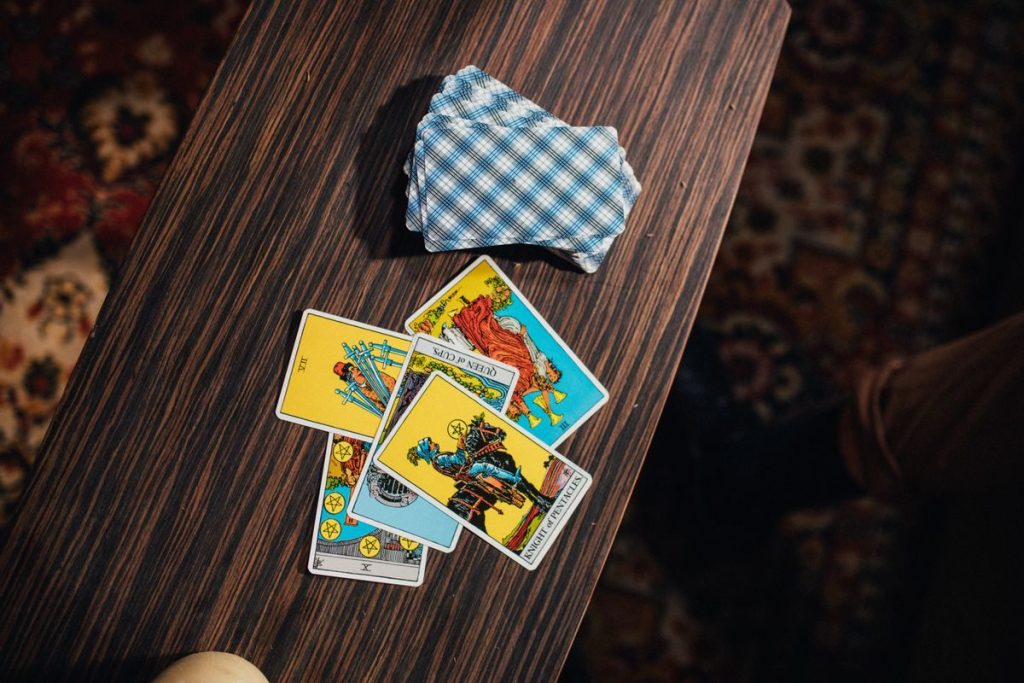
If you’ve ever looked up a tarot card meaning, you’ve almost certainly been reading about the Rider-Waite-Smith deck, whether the page said so or not. First published in 1909, this deck set the visual language that most modern tarot follows. Its pictures are the reason many people can read tarot intuitively at all. This article explains where the deck came from, what makes it different, and why it still sits behind most readings today, including free online ones.
Who made it
The deck was created in London by two members of a group interested in mysticism and symbolism. Arthur Edward Waite, a writer on occult subjects, designed the concept and wrote the accompanying book. Pamela Colman Smith, an artist and illustrator, painted all 78 images. It was published by the Rider company, which is where the “Rider” in the name comes from.
For decades it was commonly called the Rider-Waite deck. Many readers today add Smith’s name, calling it Rider-Waite-Smith, to credit the artist whose images are the main reason the deck works so well.
What made it different
Illustrated Minor Arcana
This is the big one. Before this deck, most tarot decks showed the Minor Arcana as “pip” cards: the Five of Cups would simply show five cups arranged in a pattern, much like a playing card. To read them, you had to memorise what each number and suit meant.
Smith painted a full scene on every Minor card. The Five of Cups became a cloaked figure mourning three spilled cups while two remain standing behind them. Suddenly the meaning was visible. You can look at the card and see grief, and you can also see that not everything is lost. That shift made tarot far more accessible to beginners and gave readers images to interpret intuitively.
Clear, readable symbolism
The deck’s images use symbols that are rich but understandable: sunflowers for joy, mountains for challenges, water for emotion, a bright sky for clarity, grey clouds for difficulty. Even people with no tarot knowledge often guess the general mood of a card correctly from its picture.
Reordered Major Arcana
Waite swapped the positions of two Major Arcana cards compared with older decks: Strength became card VIII and Justice became card XI. Most modern decks follow his order, though some keep the older one.
Examples of storytelling in the cards
| Card | What the image shows | Meaning it suggests |
|---|---|---|
| Three of Swords | A heart pierced by three swords in the rain | Heartbreak, painful truth |
| Six of Swords | A boat carrying figures toward calm water | Moving on, transition |
| Eight of Cups | A figure walking away from stacked cups at night | Leaving what no longer fulfils |
| Ten of Cups | A family under a rainbow | Emotional fulfilment |
| Four of Cups | A figure ignoring a cup offered from a cloud | Apathy, missed opportunity |
| Two of Cups | Two people exchanging cups | Partnership, mutual connection |
We go deeper into several of these in our card guides: Three of Swords, Ten of Cups and Two of Cups.
Why most modern meanings come from it
Because the deck was widely available and easy to learn, it became the standard reference in English-speaking countries. Many of the most popular tarot books written in the twentieth century used its images. As those books taught new generations, the meanings drawn from Smith’s pictures became the “standard” meanings. Thousands of decks published since are based on its structure and imagery, even when they change the art style completely.
So when a website says the Eight of Cups means “walking away”, it’s describing Smith’s painting of a figure walking away. The meaning and the image grew together.
Why it matters for free readings
Most free tarot readings online use this deck, or meanings derived from it. That has two advantages for you:
- Consistency. The meanings you read in a free reading match what you’ll find in most books and guides.
- Learnability. Because the images tell stories, you can start interpreting cards yourself after a few readings.
Tarotell.me uses all 78 cards of the original first printing of the deck, read upright or reversed. You can see the cards for yourself in a free tarot reading, or draw a free card of the day to start learning the images.
Learning tarot with this deck
- Look before you read. For each card, describe what you see before checking the meaning.
- Notice repeated symbols. Water, mountains, sky colour, figures facing toward or away.
- Read the Minor cards as scenes. Ask “What’s happening here?” The answer is often close to the meaning.
- Use a daily card. One card a day, studied for a minute, builds familiarity fast. See the 30-day tarot card challenge.
If you’ve drawn cards from your own deck and want help, you can enter them in Tarotell.me’s interpret my cards tool. Our guide on interpreting cards you drew at home walks through the process.
Other popular decks
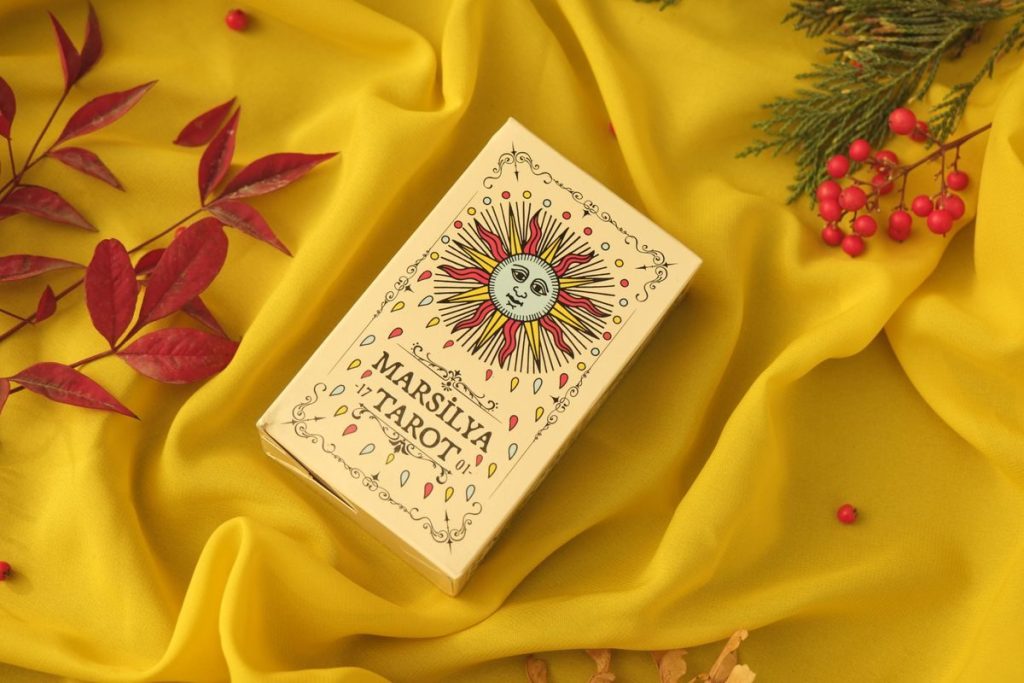
The Rider-Waite-Smith deck isn’t the only tradition. The Tarot de Marseille, much older, uses pip-style Minor cards and is popular in France and among some readers who prefer number-based reading. The Thoth deck, created later by a different occult writer and artist, uses its own symbolism and some different card names. Many modern decks are “RWS clones”: new art, same structure and scenes. If you learn on the Rider-Waite-Smith, you’ll be able to read most of them.
Have a question on your mind? Ask it in your own words, choose your cards from the 1909 deck and get a free reading written for your situation.
Frequently asked questions
Is the Rider-Waite deck the same as Rider-Waite-Smith?
Yes. The name Rider-Waite-Smith adds credit to Pamela Colman Smith, who painted the cards.
When was the deck first published?
It was first published in London in 1909.
Is it a good deck for beginners?
It’s one of the best, because every card has a scene that hints at its meaning, and most guides are written for it.
Do all tarot decks use the same meanings?
Most modern decks follow Rider-Waite-Smith meanings closely. Older and some specialist decks use different systems.
Which deck do online free readings use?
Many use the Rider-Waite-Smith imagery or meanings based on it. Tarotell.me uses the original 1909 deck.