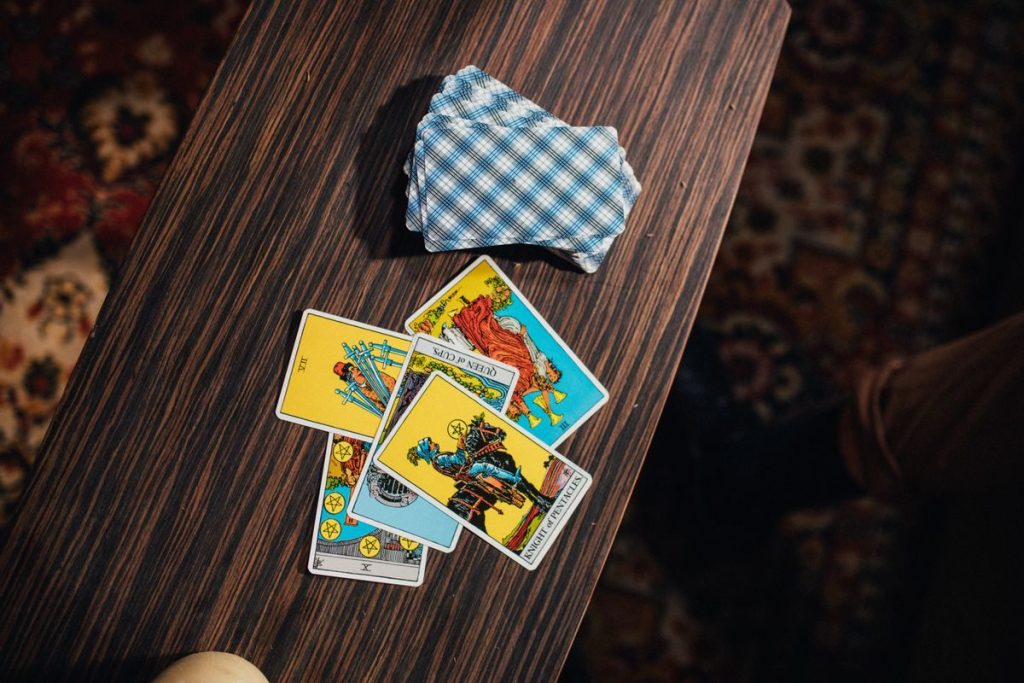
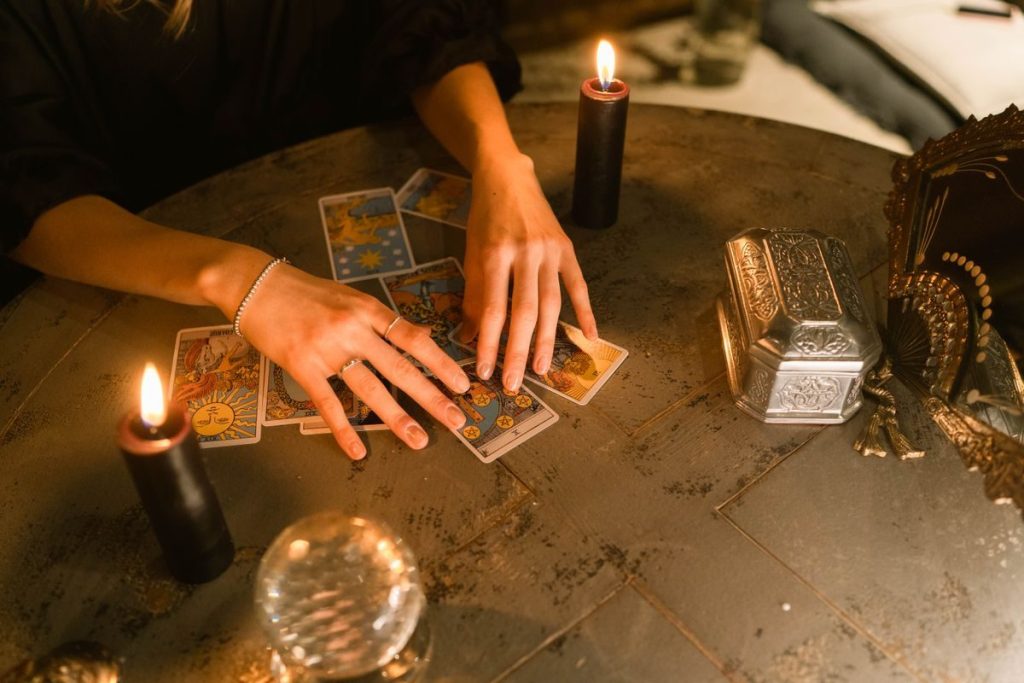
You’ve shuffled your own deck, laid out the cards, and now you’re staring at them wondering what they mean together. Looking up each card separately gives you three or five unrelated paragraphs. Turning them into one clear answer is the real skill, and it’s learnable. This guide gives you a step-by-step method that works for any spread, with a worked example at the end.
Before you start: know your positions
Interpretation begins before you draw. Each position in a spread needs a meaning, or you won’t know whether a card is the problem or the answer. If you haven’t decided on positions, use one of these:
| Spread | Positions |
|---|---|
| One card | Focus or answer |
| Three cards (A) | Situation / Obstacle / Advice |
| Three cards (B) | You / The other person / The connection |
| Five cards | Situation / Cause / Obstacle / Advice / Likely outcome |
Write the positions down along with your question. It sounds fussy, but it stops you from rearranging the meaning after you see the cards.
Step 1: Take a first look
Before reading anything, look at the whole layout for ten seconds. Notice:
- Which card jumps out at you.
- Whether the images feel bright or heavy overall.
- Whether figures face toward each other or away.
Write one line about your first impression. Beginners often find this first instinct is surprisingly close to the final reading.
Step 2: Count Major and Minor Arcana
Major Arcana cards (The Fool through The World) describe big themes and turning points. Minor Arcana cards describe everyday events. A spread with several Major cards says this situation is significant and possibly beyond your full control. A spread of mostly Minor cards says it’s about day-to-day choices you can shape.
Step 3: Look at the suits
- Cups: feelings, relationships, intuition
- Wands: energy, ambition, creativity, conflict of wills
- Swords: thoughts, words, decisions, worry
- Pentacles: money, work, body, practical matters
If you asked a love question and got mostly Swords, the issue is likely communication or overthinking rather than lack of feeling. If you asked about work and got mostly Cups, the emotional side of the job matters more than you’ve been admitting.
Step 4: Notice numbers
Aces are beginnings, twos are choices or partnerships, fives are disruption, tens are completion. Two or three cards with the same number amplify that theme. Three fives in a reading says this is a period of friction that needs working through.
Step 5: Read each card in its position
Now look up each card, but read the meaning through the position. Ask: “What does this card mean as the obstacle?” rather than “What does this card mean?” The Knight of Wands as advice says act boldly; as obstacle it says impatience is getting in the way.
Step 6: Handle reversals simply
If a card is reversed, start with the idea that its energy is blocked, delayed or turned inward. The Three of Cups reversed might mean a celebration on hold or feeling left out of a group. Only switch to an opposite meaning if that clearly fits better.
Step 7: Connect the cards
This is where a list becomes a reading. Look for:
- Story flow. Read left to right as a short story: this is happening, because of this, which leads here.
- Conflicts. If the obstacle and advice seem to clash, the advice is often how to deal with the obstacle.
- Repeated symbols. Water, sky, figures looking away; repeated images tie cards together.
Step 8: Write a three-sentence summary
Force yourself to sum up the reading in three sentences: what’s going on, what’s in the way, what to do. If you can’t, you probably haven’t connected the cards yet. Go back to Step 7.
A worked example
Question: “Should I move to a new city for a fresh start?” Spread: Situation / Obstacle / Advice.
- Situation: Six of Swords (moving on, transition toward calmer waters)
- Obstacle: Four of Pentacles (holding on tightly to security or money)
- Advice: The Fool (a leap into the unknown with openness)
Reading: Two Minor cards and one Major suggests the decision is a big turning point with practical parts you can control. The Six of Swords shows you’re already mentally moving on. The Four of Pentacles says fear of losing financial security is what’s holding you back. The Fool as advice encourages the leap, but the Fool works best with a little planning so the leap isn’t reckless.
Three-sentence summary: You’re ready to move on. Worry about money is the main block. Plan the finances, then take the step.
Common interpretation mistakes
- Reading cards without positions.
- Ignoring a card you don’t like.
- Taking scary card names literally. See the Death card in love for an example.
- Stacking too many meanings onto one card.
- Drawing extra “clarifier” cards until the answer feels comfortable.
Getting a second opinion on your cards
If you’re stuck, it helps to get another interpretation without reshuffling. Tarotell.me has an interpret my cards option: you pick the cards you drew and their positions, add your question, and get a full reading of the same cards. Comparing it with your own interpretation is one of the fastest ways to learn.
For more practice, our free tarot reading guide covers asking better questions, and our guide to the Rider-Waite-Smith deck explains the imagery most meanings are based on.
Already drew your cards at home? Pick the cards and positions you got and get them read for your question.
Frequently asked questions
Do I need to memorise all 78 cards?
No. Learn the suits and numbers first. With those, you can make sense of most Minor Arcana cards before memorising each one.
What if two cards contradict each other?
Check positions. Often one card is the problem and the other is the way through it.
Should I use reversals as a beginner?
You can start without them and add them later. If you use them, read them as blocked or delayed energy.
How long should interpreting a three-card spread take?
Ten to fifteen minutes is normal while you’re learning. It gets faster with practice.
Can I get my home-drawn cards read online?
Yes. Tarotell.me’s interpretation tool reads cards you drew yourself, with their positions and your question.