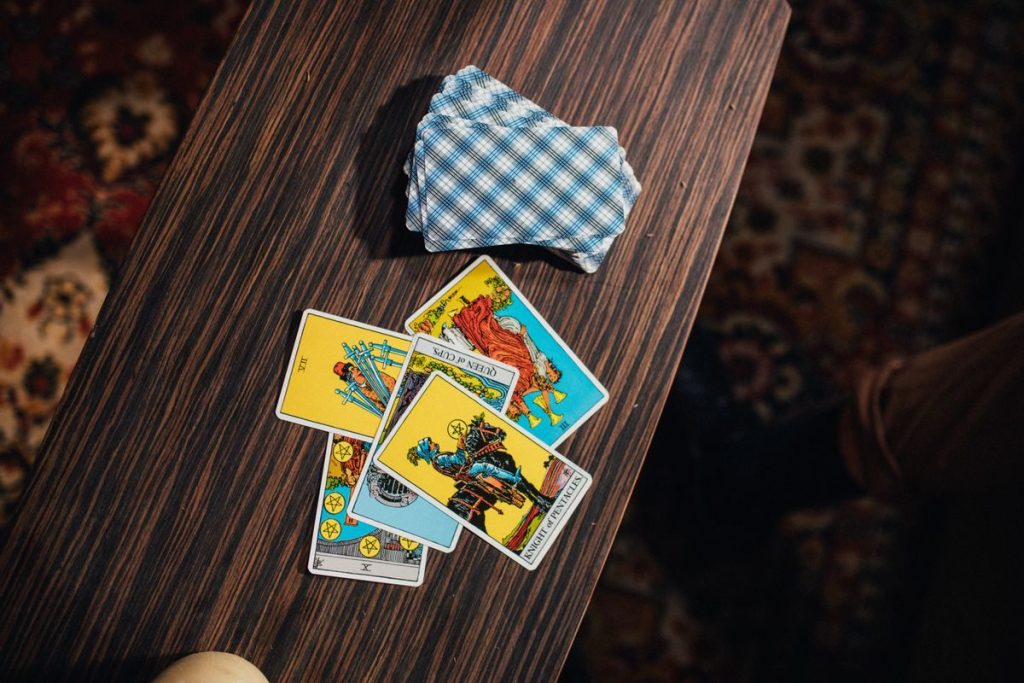
Sunday evening has a particular feeling: the weekend winding down, the week ahead taking shape. It’s a natural time for a short tarot reading. A weekly spread gives you a theme, a heads-up on challenges, and a focus, without the pressure of daily readings or big life questions. This guide gives you a simple five-card Sunday spread, explains each position, and shows how to review the week afterwards.
Why weekly works well
- Manageable. One reading a week is easy to keep up.
- Practical. A week is long enough for things to happen but short enough to plan.
- Reviewable. Next Sunday, you can see how the cards matched the week.
- Calming. It replaces vague Sunday-night dread with a clearer picture.

The five-card Sunday spread
| Position | Meaning |
|---|---|
| 1. Theme of the week | The overall energy |
| 2. Opportunity | Something to say yes to |
| 3. Challenge | Something to watch for |
| 4. Focus | Where to put your energy |
| 5. Self-care | What you need to stay well |
Lay them in a row or a small cross with the theme in the middle. It takes about ten minutes.
Reading each position
1. Theme of the week
This card sets the tone. A Major Arcana card here suggests a significant week; a Minor card suggests an ordinary one with a particular flavour. The suit tells you which area of life is in focus: Cups for relationships, Wands for projects and energy, Swords for decisions and communication, Pentacles for work and money.
2. Opportunity
Something to look out for and say yes to. The Three of Cups might mean a social invitation; the Ace of Pentacles a work opportunity; the Page of Cups a message worth answering.
3. Challenge
A heads-up, not a doom card. The Five of Wands suggests friction; the Seven of Cups distraction; the Ten of Wands overload. Knowing it’s coming helps you handle it.
4. Focus
Your priority. The Eight of Pentacles says do the detailed work; the Two of Cups says invest in a relationship; the Four of Swords says rest is the priority this week.
5. Self-care
What you need to stay balanced. The Hermit might mean time alone; Temperance moderation; the Sun fun and sunlight; the Queen of Cups emotional care.
An example week
- Theme: Two of Pentacles (juggling)
- Opportunity: Three of Pentacles (teamwork)
- Challenge: Nine of Swords (worry)
- Focus: Knight of Pentacles (steady progress)
- Self-care: Four of Swords (proper rest)
Reading: A busy week with lots to balance. Working with others will make it easier, so say yes to collaboration. Watch for late-night worrying. Focus on steady, consistent progress rather than doing everything at once. And protect your rest, especially in the evenings.
Possible actions: block out a team session on Tuesday, write a to-do list each morning, and no work emails after 9pm.
Reviewing the week
Next Sunday, before drawing a new spread, look at last week’s cards and ask:
- Did the theme fit?
- Did I notice and take the opportunity?
- How did I handle the challenge?
- Did I stick to the focus?
- Did I look after myself?
Write a line for each. Over a few months, this review is where most of the learning happens. You’ll see which cards tend to match which kinds of weeks, and you’ll get better at turning readings into action. Our guide on what to do after a tarot reading has more on reviewing.
Variations
Three-card quick version
Theme / Challenge / Advice. Five minutes, good for busy weeks.
Love-focused week
Swap positions 2 to 5 for: Connection / Tension / What to give / What to receive. See free love tarot reading.
Work-focused week
Swap for: Key task / Opportunity / Obstacle / Approach. See free career tarot reading.
Day-by-day
Draw seven cards, one per day. Fun, but it can feel predictive; treat each as a theme, not a forecast.
When the challenge card is a Major Arcana
A Major Arcana card in the challenge position deserves a little extra attention. It often points to something bigger than the week’s to-do list:
- The Hermit: you may feel isolated or need time alone, even if your schedule is full.
- The Tower: an unexpected change could disrupt your plans. Build in some slack.
- The Devil: watch for a habit, like late nights or overspending, that pulls you off track.
- The Moon: things may feel unclear. Ask questions instead of assuming.
- Justice: a fairness issue at work or home may need addressing.
Major challenges aren’t necessarily harder, but they’re worth naming early. Write the card on a sticky note or in your calendar so you remember it midweek, when it’s most likely to show up.
Combining weekly and daily cards
A weekly spread pairs nicely with a daily card. The weekly reading gives the big picture; the daily card gives a small focus each day. If you use the free daily tarot card, notice how it relates to your weekly theme. See morning or evening tarot for timing tips.
Tips
- Do it at the same time each week.
- Write the cards down, or photograph the spread.
- Choose one or two actions, not ten.
- Don’t redraw if you dislike a card.
- If something big comes up during the week, use a separate reading for it rather than reinterpreting the weekly spread.
For bigger questions, a free tarot reading on Tarotell.me lets you ask in your own words and draws a spread for that question.
Make it a habit: flip your card of the day. It takes ten seconds and earns a free credit.
Frequently asked questions
What’s the best day for a weekly tarot reading?
Sunday evening or Monday morning are popular, but any consistent day works.
How many cards should a weekly spread have?
Three to five is ideal. More can feel overwhelming for a weekly check-in.
Can I do a weekly reading and a daily card?
Yes. They work well together: the week’s big picture plus a daily focus.
Does a weekly reading predict events?
It’s best used as a guide to themes and focus, not a forecast of specific events.
What if the week didn’t match the cards?
Note it in your review. Over time, you’ll learn how the cards relate to your life.