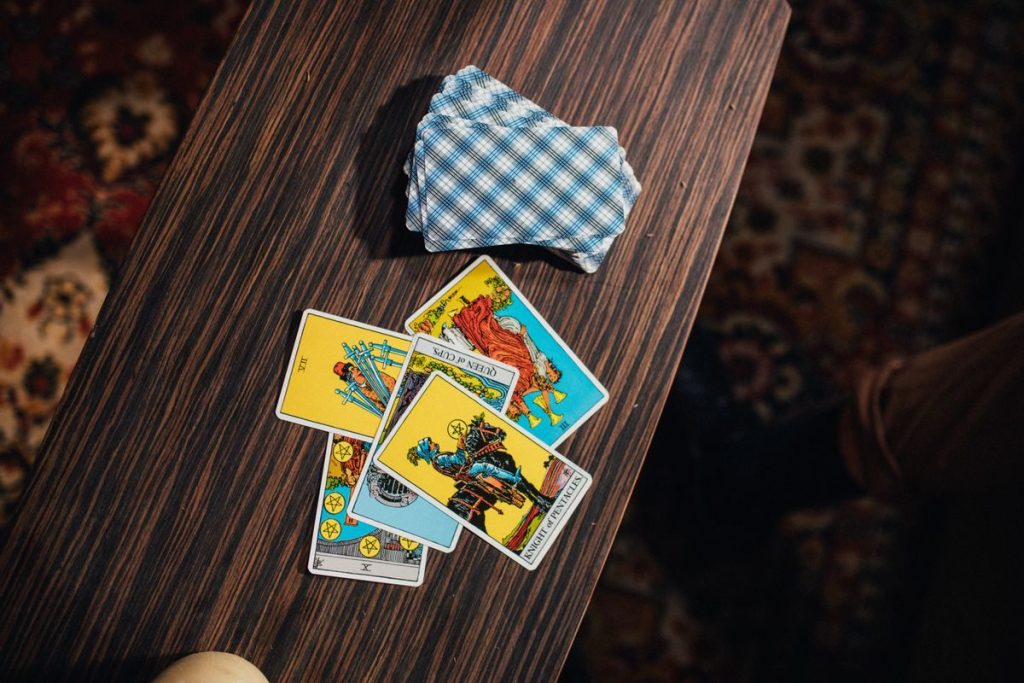

Some cards bring good financial news. Others raise a gentle (or not so gentle) flag. Warning cards in a money reading aren’t predictions of ruin. They usually point to a habit, risk or blind spot worth looking at before it becomes a bigger problem. Knowing these cards helps you read money questions honestly and turn warnings into practical steps. This guide covers the main money warning cards and what to do about each.
A reminder before we start
Tarot is for reflection, not financial advice. If a reading raises a concern about debt, investments, scams or major purchases, talk to a qualified professional or a reputable free advice service. Use the cards to notice, then use real information to decide.

The main money warning cards
Five of Pentacles: hardship and scarcity
Two figures in the snow, passing a lit window. The card points to money strain, unexpected costs, or a fear of scarcity that may be bigger than the reality. Its key message: help exists, so ask for it. See Five of Pentacles meaning.
Practical step: list your real numbers, then contact a free advice service, your bank or someone you trust.
The Devil: debt traps and unhealthy habits
Two figures chained loosely to a pedestal. The chains are loose enough to remove. In money readings, the Devil points to habits that feel impossible to break: overspending, high-interest debt, gambling, or a job you stay in only for the money.
Practical step: name the habit, then make one small change, like removing saved card details from shopping sites.
Seven of Swords: scams and dishonesty
A figure sneaking away with swords from a camp. In money matters, this card warns of deception, from scams and dodgy deals to someone not being honest about money. It can also point to your own corner-cutting.
Practical step: check any deal that seems too good, read the small print, and never send money to people you can’t verify. Our guide to tarot reading scams covers a related set of tactics.
The Tower: sudden expense or upheaval
Lightning striking a tower. Financially, it can mean an unexpected bill, job change or market shake-up. It often exposes something unstable, like having no emergency savings.
Practical step: build a small emergency fund, even a modest one, and review insurance or contracts. See the Tower for the card’s wider meaning.
Ten of Wands: financial burden
A figure struggling under a bundle of ten heavy sticks. Too many financial obligations at once: multiple loans, supporting others, taking on too much.
Practical step: list every obligation and see what can be paused, renegotiated or shared.
Seven of Cups: impulse spending and fantasy
Seven cups of dreams floating in clouds. In money readings, it points to wishful thinking, scattered spending, or chasing get-rich-quick ideas.
Practical step: wait 48 hours before non-essential purchases and be wary of schemes promising fast returns.
Four of Pentacles: holding on too tightly
A figure clutching coins. Saving is good, but this card can warn of fear-driven hoarding that stops you from spending on things that matter, like health or education.
Practical step: separate “safety savings” from money you’re allowed to use for growth.
Five of Swords: money conflict
A figure collecting swords while others walk away defeated. Disputes over money, unfair deals, or winning financially at the cost of a relationship.
Practical step: put agreements in writing and look for fair solutions rather than winning.
Quick reference
| Card | Warning | Practical step |
|---|---|---|
| Five of Pentacles | Hardship, scarcity fear | Get real numbers, ask for help |
| The Devil | Debt traps, bad habits | Change one habit |
| Seven of Swords | Scams, dishonesty | Verify before paying |
| The Tower | Sudden expense | Build an emergency fund |
| Ten of Wands | Too many obligations | Reduce or renegotiate |
| Seven of Cups | Impulse buys, fantasy | Pause before purchases |
| Four of Pentacles | Fear-driven hoarding | Separate savings goals |
| Five of Swords | Money conflict | Write agreements down |
Warning cards reversed
When these cards appear reversed, the warning often softens:
- Five of Pentacles reversed: recovery; things improving.
- The Devil reversed: breaking free from a bad habit or debt.
- Ten of Wands reversed: putting down burdens.
- The Tower reversed: a smaller shock, or avoiding a needed change.
A worked example
Question: “Is this investment opportunity a good idea?”
- The opportunity: Seven of Cups (looks dazzling, may be fantasy)
- Hidden factor: Seven of Swords (something not being disclosed)
- Advice: Page of Swords (research carefully)
Reading: The opportunity looks attractive but may not be what it seems, and something may be hidden. Research thoroughly and get independent professional advice before putting money in.
Balancing warnings with encouragement
A reading full of warnings can feel discouraging. Look for any supportive cards too, especially in the advice position. Cards like the Queen of Pentacles, Six of Pentacles or Page of Pentacles often show a practical way forward. Our guide to money tarot reading gives a full spread, and career success cards shows the positive side of work and money.
When to stop reading and start acting
If the same warning card keeps appearing, such as the Devil or the Five of Pentacles, the cards have made their point. More readings won’t add much. That’s the moment to take one practical step: open the bank app, call the advice line, cancel the subscription, or talk to the person you owe. A free yes or no card can help with a single decision, but the real change comes from the action itself.
Got a work or money decision on your mind? Ask it in your own words and get a reading written for your situation.
Frequently asked questions
Which tarot card means financial loss?
The Five of Pentacles is most associated with financial hardship. The Tower can mean sudden loss or expense.
What does the Devil mean for money?
Unhealthy money patterns like overspending or debt that feels hard to escape.
Can tarot warn me about a scam?
The Seven of Swords often appears around dishonesty. Always verify deals independently, whatever the cards say.
Should I avoid a purchase if I draw a warning card?
Use it as a prompt to check the details and your budget, then decide based on facts.
Do warning cards mean money problems are certain?
No. They point to risks or habits worth addressing, which you can often change.