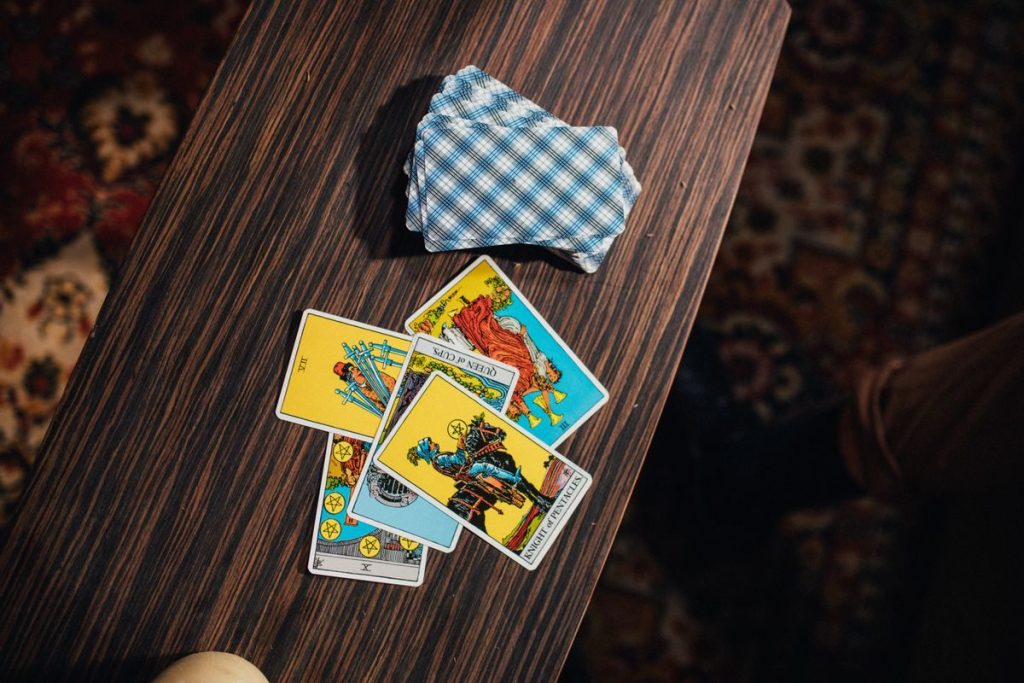

A daily tarot card takes ten seconds to draw and can shape how you see the whole day. But it’s easy to misread. People sometimes treat it as a forecast (“I drew the Tower, so today will be a disaster”) or dismiss it as random. Both miss what a daily card does well. This guide explains what your daily card is really telling you, what it isn’t, and a simple method for reading it quickly.
What a daily card is
A daily card is a single card drawn each morning or evening, usually without a specific question. It works best as a theme: something to notice, think about or practise during the day. It’s less a prediction and more a lens. If you draw the Two of Cups, you might notice connections more. If you draw the Four of Swords, you might give yourself permission to rest.
You can draw it from your own deck or use a free daily tarot card. On Tarotell.me, flipping your daily card also earns a free credit toward a fuller reading.

What your daily card isn’t
- Not a fixed forecast. The Tower in the morning doesn’t mean your house will collapse. It might mean an unexpected change of plans, or a realisation.
- Not a judgement. A hard card doesn’t mean you’re doing something wrong.
- Not an answer to a big question. If you’re secretly asking about a relationship, a daily card gives a hint at most. Use a proper spread for big questions.
- Not something to redraw. If you don’t like it, sit with it rather than pulling another.
A three-question method
When you draw your card, ask yourself:
- What do I see? Describe the image: people, colours, mood. The Rider-Waite-Smith deck tells stories in its pictures, so this alone often gets you close to the meaning. See the Rider-Waite-Smith deck.
- What’s the core meaning? One keyword or phrase. Five of Cups: disappointment, focusing on loss.
- Where might this show up today? At work? In a conversation? In how you treat yourself?
That’s it. The whole thing takes a minute or two.
Examples
| Card | Theme for the day | Possible action |
|---|---|---|
| Ace of Wands | A spark of inspiration | Write down the idea before it fades |
| Four of Swords | Rest and recovery | Take a real break at lunch |
| Page of Cups | A sweet message or feeling | Send a kind text to someone |
| Five of Wands | Friction or competition | Pick your battles today |
| The Hermit | Reflection, solitude | Spend 15 minutes alone thinking |
| Eight of Pentacles | Focused work | Do one task carefully and well |
| The Tower | Unexpected change | Stay flexible; don’t over-plan |
| The Star | Hope and calm | Notice what’s getting better |
Difficult daily cards
Drawing a heavy card first thing can be unsettling. Some ways to reframe:
- Three of Swords: be gentle with yourself and others; something may sting, and that’s okay.
- Ten of Swords: something is ending, maybe just a bad mood or an old worry.
- Nine of Swords: notice anxious thoughts without believing all of them.
- Death: let go of one thing today, like a habit or a grudge. See the Death card.
- The Devil: watch for a habit that pulls you in.
Hard cards often turn out to be the most useful, because they point to something you might otherwise ignore.
Reversed daily cards
If you use reversals, a reversed daily card often means the theme is internal or blocked. The Sun reversed might mean you’re happy but not showing it, or that joy needs a little effort today. Keep it simple: “Same theme, but turned inward or slowed down.”
Keeping a daily card log
Writing down your card each day turns it into a learning tool. Note the card, one keyword and one line about what happened. After a few weeks, you’ll:
- Know many card meanings without looking them up.
- Notice repeat cards. See why you keep pulling the same card.
- See patterns in your moods and weeks.
Our 30-day tarot card challenge builds this into a structured month.
Morning or evening?
A morning card sets an intention; an evening card helps you reflect. Both work. Our guide to morning or evening tarot helps you choose, and tonight’s card ritual covers the evening version.
Daily cards for specific areas
You can also give your daily card a focus. “What do I need to know about work today?” makes it a work card. See daily tarot for work. “What should I remember about love today?” makes it a love card. See love tarot card of the day.
Learning the deck one card a day
A daily card is one of the easiest ways to learn tarot. With 78 cards, you’ll see most of the deck within three or four months of daily draws. Each card arrives with a real day attached to it, which makes it far more memorable than reading a list of meanings. Many readers say their most reliable card knowledge came from cards they drew on days when something happened that matched.
When a daily card isn’t enough
If you find yourself wanting more from the daily card, like an answer to a specific question, switch to a fuller reading. A free tarot reading on Tarotell.me lets you ask in your own words and draw a spread for the question. The daily card can stay as your light morning ritual alongside it.
Make it a habit: flip your card of the day. It takes ten seconds and earns a free credit.
Frequently asked questions
Does my daily tarot card predict my day?
It’s better seen as a theme to notice than a prediction of events.
What if I draw a scary card in the morning?
Treat it as something to be aware of, not a warning of disaster. Hard cards often point to small, useful adjustments.
Should I ask a question when I draw my daily card?
You can, but many people draw without a question and treat the card as a general theme.
Can I draw more than one daily card?
One is usually best. More cards turn it into a spread, which works better for specific questions.
How long should I spend on my daily card?
One or two minutes is plenty. The value comes from doing it regularly.